
White-Label Voice AI: Wrappers vs Integrated Platforms - What Agencies Need to Know
Wrappers add white-label UI to third-party infrastructure, while native platforms own the full voice AI stack - the difference determines your margins, reliability, and client experience.
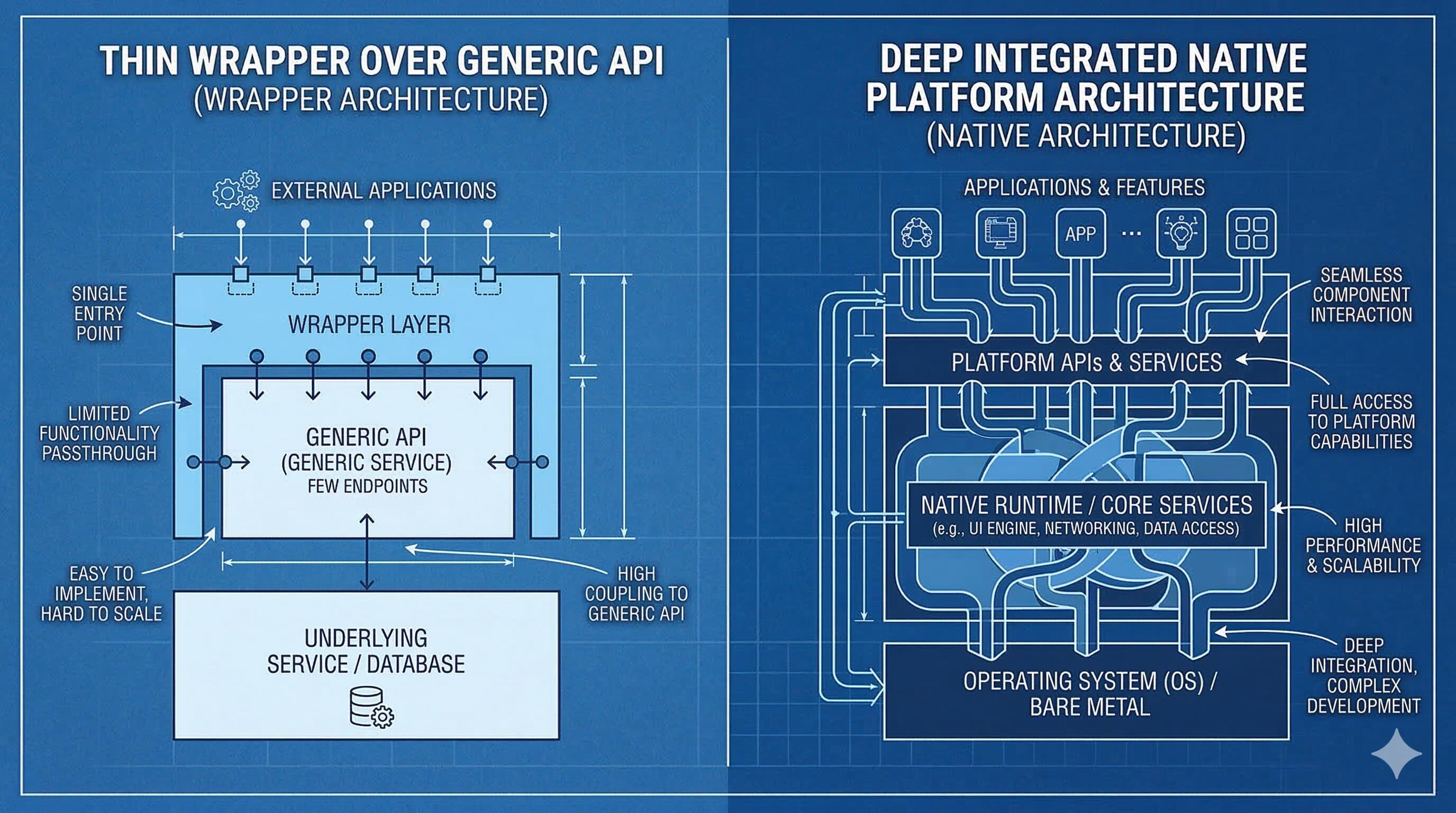
The voice AI agency market in January 2026 is split between two fundamentally different architectures: wrapper platforms that rebrand existing providers like VAPI and Retell, and native platforms that own their infrastructure end-to-end. This distinction matters more than most agencies realize when evaluating white-label options.
Understanding the technical and business implications of each approach can mean the difference between building a sustainable agency and one that faces constant infrastructure surprises.
Which Trillet product is right for you?
Small businesses: Trillet AI Receptionist - 24/7 call answering starting at $49/month
Agencies: Trillet White-Label - Resell to clients starting at $99/month
What Is a Voice AI Wrapper Platform?
A voice AI wrapper is a white-label interface built on top of third-party voice AI infrastructure like VAPI, Retell AI, or Voiceflow.
Wrapper platforms provide the dashboard, client management, and branding layer while routing all voice traffic through an underlying provider. Your API calls go to the wrapper, which then forwards them to VAPI or Retell, which then processes the actual voice AI functionality.
Common wrapper platforms as of January 2026:
Platform | Wraps | Monthly Cost | Provider Options |
Voicerr | VAPI + Retell | $28/month | Dual-provider |
Vapify | VAPI only | $29-399/month | Single-provider |
VoiceAIWrapper | VAPI, Retell, ElevenLabs | $29-499/month | Multi-provider |
ChatDash | Voiceflow/Retell | $120-600/month | Limited |
The wrapper model gained popularity in 2024-2025 as agencies sought quick market entry without building infrastructure. However, the architecture creates dependencies that compound over time.
What Is a Native Voice AI Platform?
Native platforms own the complete voice AI stack, from telephony integration to LLM orchestration to speech synthesis.
When you white-label a native platform, there is no middle layer between you and the infrastructure owner. Your business relationship is direct with the company that controls the voice AI stack.
Native platforms handle voice processing, conversation logic, and telephony directly rather than licensing it from third parties. This architectural difference affects everything from debugging capabilities to feature availability to long-term pricing stability.
Does the Wrapper Architecture Affect Call Quality?
Wrappers are UI layers, not call processing layers. Voice traffic flows directly between your client and the underlying provider (VAPI, Retell, etc.) without passing through the wrapper's servers.
This means wrapper platforms do not add latency to calls. The call quality you get from a wrapper is identical to what you would get connecting directly to the underlying provider.
What wrappers actually do:
Provide a branded dashboard for agent configuration
Manage client sub-accounts and billing
Display analytics pulled from the underlying provider's API
Handle authentication and access control
What wrappers do not do:
Process voice traffic
Route calls through their infrastructure
Add processing delays to conversations
The real differences between wrappers and native platforms lie elsewhere: provider dependency, compliance complexity, feature limitations, and support paths.
What Happens When Your Wrapper's Provider Has an Outage?
Provider outages cascade through every wrapper built on that infrastructure. Your clients experience downtime regardless of your platform's own reliability.
January 2026 reality check: When VAPI experiences infrastructure issues, every agency using Vapify, Voicerr (VAPI mode), or VoiceAIWrapper (VAPI backend) simultaneously loses service. There is nothing the wrapper vendor can do except wait for VAPI to resolve the issue.
This creates several business risks:
No control over resolution timeline - Your clients ask why service is down, and your honest answer is "our provider's provider is fixing it"
Cascading support burden - Your support team handles angry clients while your wrapper vendor handles you while the underlying provider handles them
Reputation damage - Clients blame your agency, not the infrastructure layers you cannot see
SLA complications - Your SLA promises may exceed what your wrapper stack can actually deliver
Native platforms experience outages too, but the chain of responsibility is shorter. When an issue occurs, the platform can immediately begin diagnostics and resolution rather than opening tickets with upstream vendors.
How Do Pricing Structures Differ Between Wrappers and Native Platforms?
Wrapper platforms charge subscription fees on top of underlying provider costs. Native platforms offer more predictable per-minute pricing.
Wrapper pricing structure (typical):
Cost Component | Who Pays | Example |
Wrapper subscription | Agency | $28-499/month |
Provider per-minute | Agency (pass-through) | $0.12-0.17/minute |
Telephony | Often separate | $0.01-0.02/minute |
Total cost | Agency | Subscription + usage + telephony |
Native platform pricing structure:
Cost Component | Who Pays | Example |
Platform subscription | Agency | $99-299/month |
Per-minute (all-inclusive) | Agency | $0.09/minute |
Total cost | Agency | Subscription + usage |
The hidden complexity in wrapper pricing comes from managing multiple billing relationships. Your wrapper charges monthly, your underlying provider charges per-minute, and telephony might be a third vendor. Reconciling these invoices against client revenue becomes accounting overhead.
Native platforms typically bundle infrastructure costs into a single per-minute rate, making margin calculations straightforward.
What Are the Support Implications of Each Architecture?
Debug paths differ dramatically between wrapper and native architectures. This affects how quickly you can resolve client issues.
Wrapper support path:
Client reports issue to your agency
You investigate in wrapper dashboard
Wrapper support opens ticket with underlying provider
Provider investigates their infrastructure
Resolution flows back through the chain
Native platform support path:
Client reports issue to your agency
You investigate in platform dashboard
Platform support investigates their infrastructure directly
Resolution provided
The wrapper path introduces 24-48 hours of additional latency for complex issues that require provider-level investigation. For time-sensitive client problems, this delay can damage relationships.
Additionally, wrapper vendors often have limited visibility into what their underlying providers are doing. They see API responses but not the internal processing that generated them. This makes root cause analysis harder and resolution times longer.
How Do Wrappers Handle Compliance and Security?
Compliance certifications pass through multiple layers in wrapper architectures. Each layer must maintain compliance for the overall system to meet requirements.
Critical compliance question: If VAPI is HIPAA-compliant and your wrapper is HIPAA-compliant, is the combined system HIPAA-compliant?
The answer depends on:
How data flows between layers
Whether Business Associate Agreements (BAAs) exist at each layer
Where call recordings and transcripts are stored
How PII traverses the wrapper-to-provider boundary
Many wrapper platforms as of January 2026 do not publish security certifications. Voicerr, for example, does not list SOC 2, HIPAA, or GDPR compliance on their documentation. Agencies serving healthcare or financial clients cannot safely use uncertified wrappers regardless of underlying provider certifications.
Native platforms with direct compliance certifications offer clearer audit trails:
Platform Type | Compliance Path | Audit Complexity |
Wrapper | Agency + Wrapper + Provider | Complex, multi-vendor |
Native | Agency + Platform | Direct, single-vendor |
For agencies targeting regulated industries, the simplified compliance path of native platforms reduces legal risk and client objections.
What Is Provider Lock-In Risk?
Wrapper platforms depend entirely on their underlying providers' continued operation and pricing stability.
Provider lock-in scenarios:
Pricing changes - If VAPI increases per-minute rates, every VAPI-based wrapper immediately sees margin compression. Agencies cannot negotiate directly with VAPI because they are not VAPI customers.
Feature deprecation - Providers regularly modify APIs. When VAPI deprecates a feature your wrapper uses, the wrapper vendor must update their integration. Until they do, that feature breaks for your clients.
Acquisition or shutdown - The PlayAI acquisition by Meta in July 2025, which led to complete service shutdown by December 31, 2025, demonstrated this risk. 40,000+ users lost their voice AI infrastructure because Meta wanted the team, not the product.
Terms of service changes - Providers can modify acceptable use policies. If your wrapper's provider decides certain use cases violate their terms, your agency loses that capability overnight.
Native platforms face market risks too, but they control their own pricing, features, and policies. The risk of sudden external changes is lower.
How Should Agencies Evaluate Wrapper vs Native Options?
The evaluation framework differs based on agency priorities and client base.
Choose a wrapper if:
You need absolute lowest entry cost (some wrappers start at $28/month)
Your use case is simple and low-volume
You are testing market demand before committing to infrastructure
Your clients do not require compliance certifications
You accept dependency risk as a tradeoff for lower initial investment
Choose a native platform if:
You need predictable per-minute costs for accurate margin planning
Your clients require compliance certifications (HIPAA, SOC 2, GDPR)
You need infrastructure-level features (honeypot detection, multi-agent orchestration)
You want a direct support relationship with infrastructure owners
You are building a sustainable long-term agency business
Platform Comparison: Wrappers vs Native
Factor | Wrapper Platforms | Native Platforms |
Entry cost | $28-120/month | $99-299/month |
Per-minute rate | $0.12-0.17+ (provider cost) | $0.09/minute (Trillet) |
Call quality | Provider dependent | Platform controlled |
Outage control | None (provider dependent) | Direct |
Compliance | Complex multi-layer | Direct certification |
Support path | Indirect | Direct |
Pricing stability | Provider dependent | Platform controlled |
Feature roadmap | Provider dependent | Platform controlled |
For detailed pricing analysis across specific platforms, see White Label AI Chatbot Pricing Comparison.
Why Are Agencies Switching From Wrappers to Native Platforms?
The wrapper-to-native migration trend accelerated in late 2025 as agencies encountered real-world limitations.
Common migration triggers:
Margin pressure - Wrapper subscription + provider per-minute + telephony costs erode margins faster than expected at scale
Feature limitations - Agencies discover they need capabilities that require infrastructure-level access the wrapper cannot provide
Compliance requirements - New clients require certifications the wrapper stack cannot provide
Support frustration - Multi-layer debug paths slow issue resolution below acceptable thresholds
Provider instability - Outages or pricing changes at the infrastructure layer create unpredictable business disruption
Agencies making the switch typically report that the native platform's slightly higher subscription cost is offset by lower per-minute rates and reduced operational overhead within 2-3 months.
For a deeper look at specific wrapper risks, read The Hidden Costs of Voice AI Wrappers.
What Native Platform Features Do Wrappers Typically Lack?
Native platforms can implement features that wrapper architectures cannot support due to infrastructure limitations.
Features commonly available on native platforms but not wrappers:
Honeypot detection - Identifying trap numbers before wasting credits requires deep telephony integration that wrappers cannot access
Multi-agent orchestration - Seamless handoffs between specialized agents need infrastructure-level coordination
Dynamic conversation architecture - Agents that can backtrack and revise approach mid-conversation require tight LLM-telephony integration
On-premise deployment - Wrappers cannot offer self-hosted options because they do not control the infrastructure
These features matter for agencies differentiating beyond price. When every competitor offers the same underlying VAPI or Retell capabilities, the wrapper layer adds little unique value.
Frequently Asked Questions
What is the biggest risk of using a voice AI wrapper?
Provider dependency. When your wrapper's underlying provider has outages, pricing changes, or feature modifications, your agency has no control over resolution and must pass the impact directly to clients.
Do wrappers affect call quality?
No. Wrappers are UI layers that do not process voice traffic. Calls flow directly between your client and the underlying provider. Your call quality depends entirely on which provider (VAPI, Retell, etc.) the wrapper connects to, not on the wrapper itself.
Are wrappers always cheaper than native platforms?
At low volumes, wrappers may have lower subscription costs. However, per-minute rates from underlying providers ($0.12-0.17/minute) often exceed native platform rates ($0.09/minute), making native platforms cheaper at scale.
Which Trillet product should I choose?
If you're a small business owner looking for AI call answering, start with Trillet AI Receptionist at $49/month. If you're an agency wanting to resell voice AI to clients, explore Trillet White-Label - Studio at $99/month (up to 3 sub-accounts) or Agency at $299/month (unlimited sub-accounts).
Do wrappers support HIPAA compliance?
Most wrapper platforms do not publish compliance certifications. Even if the underlying provider (VAPI, Retell) is HIPAA-compliant, the wrapper layer must also maintain compliance for the full stack to meet requirements. Verify certifications directly with the wrapper vendor before deploying for healthcare clients.
How do I migrate from a wrapper to a native platform?
Migration typically involves exporting agent configurations, knowledge bases, and integration settings from your current wrapper, then recreating them on the native platform. Most agencies complete migration within 1-2 weeks with minimal client disruption.
Conclusion
The wrapper vs native platform decision shapes your agency's operational ceiling. Wrappers offer lower barriers to entry but create long-term dependencies that limit growth, complicate compliance, and restrict access to infrastructure-level features.
Native platforms like Trillet White-Label require modestly higher initial investment but provide direct infrastructure control, predictable pricing at $0.09/minute, and features like honeypot detection and multi-agent orchestration that wrappers cannot replicate.
For agencies building sustainable voice AI businesses, the native platform architecture delivers better margins, cleaner support paths, and fewer infrastructure surprises.
Related Resources: