
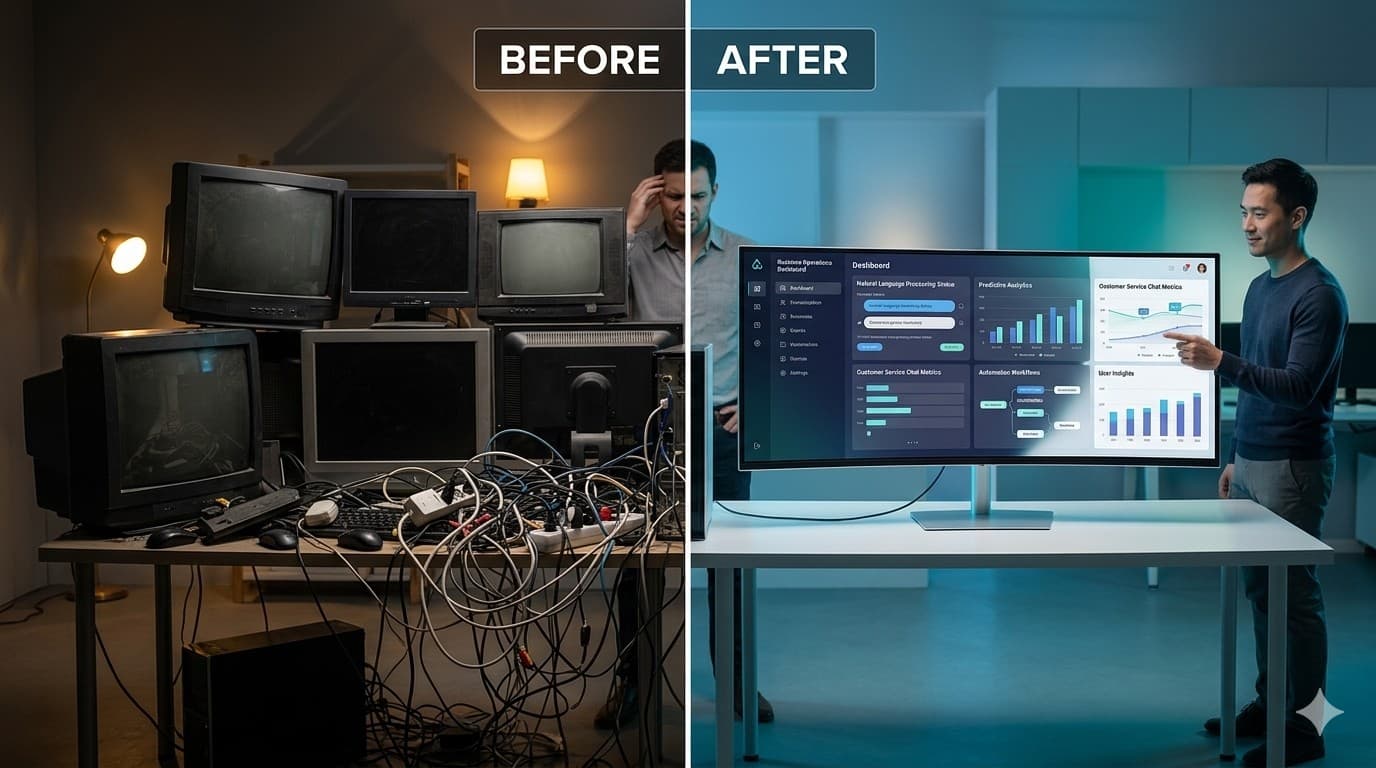
AI Voice Agent Without a Frankenstein Tech Stack: Unified Platforms vs Multi-Vendor Integration
Agencies stitching together 5-8 tools to deliver voice AI are bleeding money, losing uptime, and drowning in support tickets — native unified platforms eliminate multi-vendor integration entirely.
If you have ever stared at a broken Zapier automation at 11 PM on a Friday, wondering which of your seven subscriptions caused the cascade failure, you already understand the Frankenstein stack problem. Agencies across the voice AI space are gluing together automation platforms, telephony providers, CRM connectors, billing tools, and compliance add-ons just to deliver a service that should work out of the box. Every vendor in the chain is another invoice, another login, another potential point of failure, and another support team that will point at someone else when things break.
Native unified platforms like Trillet collapse this entire stack into a single product with built-in telephony, integrations, billing, and compliance. The result: fewer moving parts, higher uptime, better margins, and clients who actually stay.
Which Trillet product is right for you?
Small businesses: Trillet AI Receptionist - 24/7 call answering starting at $49/month
Agencies: Trillet White-Label - Resell to clients starting at $99/month
What Is the Frankenstein Tech Stack Problem?
The Frankenstein stack is an agency's voice AI delivery system built by bolting together multiple unrelated tools that were never designed to work as one product.
A typical agency Frankenstein stack looks something like this:
Voice AI engine — VAPI, Retell, or Bland for the actual call handling
Automation layer — Zapier, Make, or n8n to connect everything
CRM — GoHighLevel, HubSpot, or a separate system for lead management
Telephony — Twilio or a separate provider for phone numbers and routing
Billing — Stripe configured manually, or a separate invoicing tool
Compliance — Third-party TCPA/DNC scrubbing services
Dashboard — A wrapper platform or custom portal for client access
Knowledge base — Yet another tool for agent training data
Each tool does its job reasonably well in isolation. The problem is that they were never designed to talk to each other natively, so you spend as much time maintaining the glue between them as you do serving clients. When one vendor pushes an update, it breaks the automation that connects it to the next tool. When a client reports a problem, you open four different dashboards trying to trace where the call went wrong.
This is not engineering. It is stitchwork.
Why Do Multi-Vendor Stacks Fail So Often?
Every integration between two tools is a failure point, and stacking five or more creates compounding reliability risk that most agencies never calculate.
The uptime math agencies ignore:
If each service in your stack maintains 99.5% uptime individually — which is considered good — the effective uptime of the combined stack is the product of all of them:
0.995 x 0.995 x 0.995 x 0.995 x 0.995 = 97.5% effective uptime
That 97.5% sounds acceptable until you do the monthly math: 18+ hours of potential downtime every month. For agencies promising 24/7 call answering to clients, 18 hours of downtime means missed leads, angry business owners, and refund requests.
And that 99.5% per service is generous. Zapier had multiple significant outages in 2025. VAPI and Retell have both experienced downtime events that rippled through every wrapper and agency built on top of them. When PlayAI was acquired by Meta in July 2025 and shut down entirely by December 31, 2025, every agency dependent on that provider lost their infrastructure overnight.
Common failure scenarios in multi-vendor stacks:
Zapier webhook fails silently, leads stop flowing to CRM for hours before anyone notices
VAPI pushes an API update, your Make automation breaks, calls go unanswered
Twilio changes number provisioning rules, new client onboarding stalls
Your billing integration double-charges a client because two automations fired simultaneously
A compliance scrubbing service goes down, calls go out to numbers on the Do Not Call registry
Each of these has happened to real agencies. Each one costs time, money, and client trust.
What Does a Frankenstein Stack Actually Cost?
The sticker price of each individual tool obscures the true cost of a multi-vendor stack — when you add up subscriptions, per-unit fees, and the time spent maintaining integrations, the numbers are painful.
Component | Frankenstein Stack | Trillet Unified Platform |
Voice AI engine (VAPI/Retell) | $0.12-0.16/minute | Included at $0.12/minute |
Automation (Zapier Pro) | $29-73/month | Native integrations included |
CRM connector | $20-50/month add-on | GoHighLevel, HubSpot built in |
Telephony (Twilio) | $1/number + $0.02/min | Built-in telephony included |
Billing setup (Stripe + portal) | $0 + hours of config | Native Stripe billing included |
Compliance (TCPA/DNC scrubbing) | $50-150/month | Built-in TCPA/ACMA/GDPR/DNCR |
Client dashboard (wrapper) | $28-49/month | White-label dashboard included |
Total monthly (before call volume) | $128-323/month + per-minute | $99-299/month all-in |
Per-minute rate | $0.12-0.16 | $0.12 |
Effective uptime | ~97.5% (18+ hrs downtime/mo) | Single-vendor SLA |
Support tickets when something breaks | 3-5 vendors to coordinate | One team, end-to-end |
At 1,000 minutes per month of call volume across your client base, the per-minute difference can save up to $40 monthly compared to Vapi-based stacks. Factor in the subscription savings and the hours you are not spending debugging broken automations, and the unified platform pays for itself before you account for the revenue you keep by not losing clients to downtime.
How Does the Support Nightmare Work With Multiple Vendors?
When something breaks in a Frankenstein stack, you enter the no-accountability loop — each vendor points at the next, and your client's phones stay down while you play detective.
Here is what the support experience actually looks like:
Client calls you: "My AI agent hasn't answered a call in two hours."
You check your wrapper dashboard — it looks fine.
You check VAPI — their status page says "All Systems Operational."
You check Zapier — a webhook timed out three hours ago, silently.
You rebuild the Zapier automation. It fires. Calls resume.
You have lost two hours of leads for your client. Nobody is accountable.
Now multiply that by ten clients and three incidents per month. You are spending your evenings troubleshooting integration failures instead of selling new accounts or improving your service.
With a native platform, the support path is direct: you report the issue, one engineering team investigates across telephony, voice AI, and integrations, and the fix comes from a single source. No finger-pointing between vendors. No "that's not our layer" responses.
The Discord support trap makes this worse for agencies using wrapper platforms. Most wrappers point to community Discord servers as their primary support channel. But community members are other agencies with the same problems — they cannot fix infrastructure issues any more than you can. When VAPI goes down, Discord becomes a complaint forum, not a solution center.
What Integrations Does a Unified Platform Replace?
A native voice AI platform replaces the entire automation layer by building the most common agency integrations directly into the product.
What Trillet replaces in a typical Frankenstein stack:
Zapier/Make/n8n — Native integrations with GoHighLevel, HubSpot, Google Calendar, and Meta lead forms mean you do not need a middleware layer to connect your voice agent to client systems. When a call ends, the lead data flows directly into the CRM without an automation platform in between.
Separate telephony provider — Built-in telephony eliminates the need for a Twilio account, number provisioning workflows, and per-minute telephony charges stacked on top of your voice AI costs.
Separate billing system — Native Stripe billing lets you set client pricing, manage subscriptions, and handle invoicing from the same dashboard where you manage voice agents. No more maintaining a separate billing portal or building custom Stripe integrations through Zapier.
Separate compliance tools — Built-in TCPA, ACMA, GDPR, and DNCR compliance removes the need for third-party scrubbing services or manual Do Not Call list management. For agencies serving healthcare clients, compliance is not an add-on — it is part of the platform.
Separate CRM connectivity — CRM integration is native, not bolted on through webhooks. Lead data, call recordings, transcripts, and follow-up actions flow into GoHighLevel or HubSpot without middleware configuration.
The difference is not just convenience. Every eliminated integration is one fewer failure point, one fewer subscription, and one fewer vendor to coordinate with when something goes wrong. For a deeper look at the risks of relying on wrapper architectures, see The Hidden Costs of Voice AI Wrappers.
How Does a Frankenstein Stack Limit Your Ability to Scale?
Scaling a multi-vendor stack means scaling every vendor simultaneously — and the complexity grows exponentially, not linearly.
When you onboard your fifth client on a Frankenstein stack, the cracks start showing. By the tenth, they are canyons.
Scaling pain points with multi-vendor stacks:
Onboarding time multiplies. Every new client requires configuring the voice AI engine, setting up automations, connecting the CRM, provisioning phone numbers, and configuring billing. What could be a 15-minute setup on a unified platform becomes a 2-3 hour project across multiple tools.
Automation limits hit fast. Zapier's Pro plan caps at 2,000 tasks per month. Ten active clients with moderate call volume will blow through that in weeks, pushing you to the $73/month Team plan or higher. Make and n8n have similar scaling cliffs.
Debugging becomes archaeology. With ten clients on separate automations, finding which client's workflow broke — and why — requires digging through logs across multiple platforms. A single missed webhook can take an hour to diagnose when you are checking three different dashboards.
Vendor pricing changes hit harder at scale. When VAPI raises per-minute rates or Zapier increases plan pricing, the cost impact multiplies across your entire client base. Agencies on native platforms with stable, controlled pricing are insulated from upstream price shocks.
Client reporting requires data stitching. Pulling together call metrics, lead data, and billing information from three or four different tools to build a client report is a time sink that native platforms eliminate with unified analytics dashboards.
Native platforms are built to scale because the integrations, billing, compliance, and analytics all grow together as you add clients. There is no point where you hit a Zapier task limit and have to restructure your entire automation layer.
What Should Agencies Look for in a Unified Voice AI Platform?
A unified platform should replace your entire multi-vendor stack with native capabilities — not just add another layer on top of it.
Before switching from a Frankenstein stack, evaluate platforms against these criteria:
Native telephony — Phone numbers, call routing, and SIP connectivity should be built in, not dependent on a separate Twilio account.
Native CRM integration — GoHighLevel, HubSpot, and calendar connectivity should work without Zapier or Make in between.
Native billing — Stripe billing for client subscriptions should be part of the platform, not a separate integration you maintain.
Native compliance — TCPA, ACMA, GDPR, and DNCR compliance should be built in, not bolted on through third-party services.
White-label dashboard — Your clients should see your brand, not a patchwork of different tools.
Single-vendor support — When something breaks, one team should own the entire problem from telephony to AI to integrations.
Stable pricing — Per-minute rates should be controlled by the platform, not subject to upstream provider changes.
Trillet checks every box on this list. The platform was built as a native voice AI system, not a wrapper adding a dashboard on top of VAPI or Retell. For a detailed comparison of platform architectures, see Voice AI Wrappers vs Native Platforms.
Frequently Asked Questions
Can I keep using Zapier with a unified platform if I want custom automations?
You can, but you probably will not need to. Native platforms handle the most common agency workflows — CRM updates, calendar bookings, lead notifications, billing — without external automation tools. For truly custom workflows, most native platforms offer APIs that connect directly without middleware.
Which Trillet product should I choose?
If you're a small business owner looking for AI call answering, start with Trillet AI Receptionist at $49/month. If you're an agency wanting to resell voice AI to clients, explore Trillet White-Label at $99/month (Studio, up to 3 sub-accounts) or $299/month (Agency, unlimited sub-accounts).
How long does it take to migrate from a Frankenstein stack to a unified platform?
Most agencies complete migration within a few days. The voice agent configuration, phone number porting, and CRM connections that took hours to set up across multiple tools can be configured in a single platform in minutes. The hardest part is usually deciding to stop paying for tools you no longer need.
Is a unified platform more expensive than building your own stack?
Typically no. When you add up VAPI/Retell per-minute rates, Zapier subscriptions, Twilio fees, compliance tools, and the hours spent maintaining integrations, a unified platform at $99-299/month with $0.12/minute calling is comparable or cheaper — with significantly less operational overhead.
What happens if a unified platform has an outage?
Single-vendor outages are simpler to resolve than multi-vendor cascading failures. One engineering team diagnoses and fixes the issue across the entire stack. There is no blame-shifting between providers, no waiting for three different vendors to coordinate, and no silent webhook failures that go undetected for hours.
Conclusion
The Frankenstein tech stack was never a strategy — it was a workaround agencies adopted because no unified voice AI platform existed. Now it does. Agencies spending $130-320 per month across 5-8 tools, absorbing 18+ hours of compounding downtime risk, and burning evenings on integration debugging have a clear alternative: a single native platform that includes telephony, integrations, billing, and compliance from day one.
Stop maintaining the monster. Explore Trillet White-Label starting at $99/month with $0.12/minute calling, native Stripe billing, and built-in compliance — everything your Frankenstein stack does, without the stitches.
Related Resources: